Service Dogs in Washington: Training, Access Rights and Where to Start
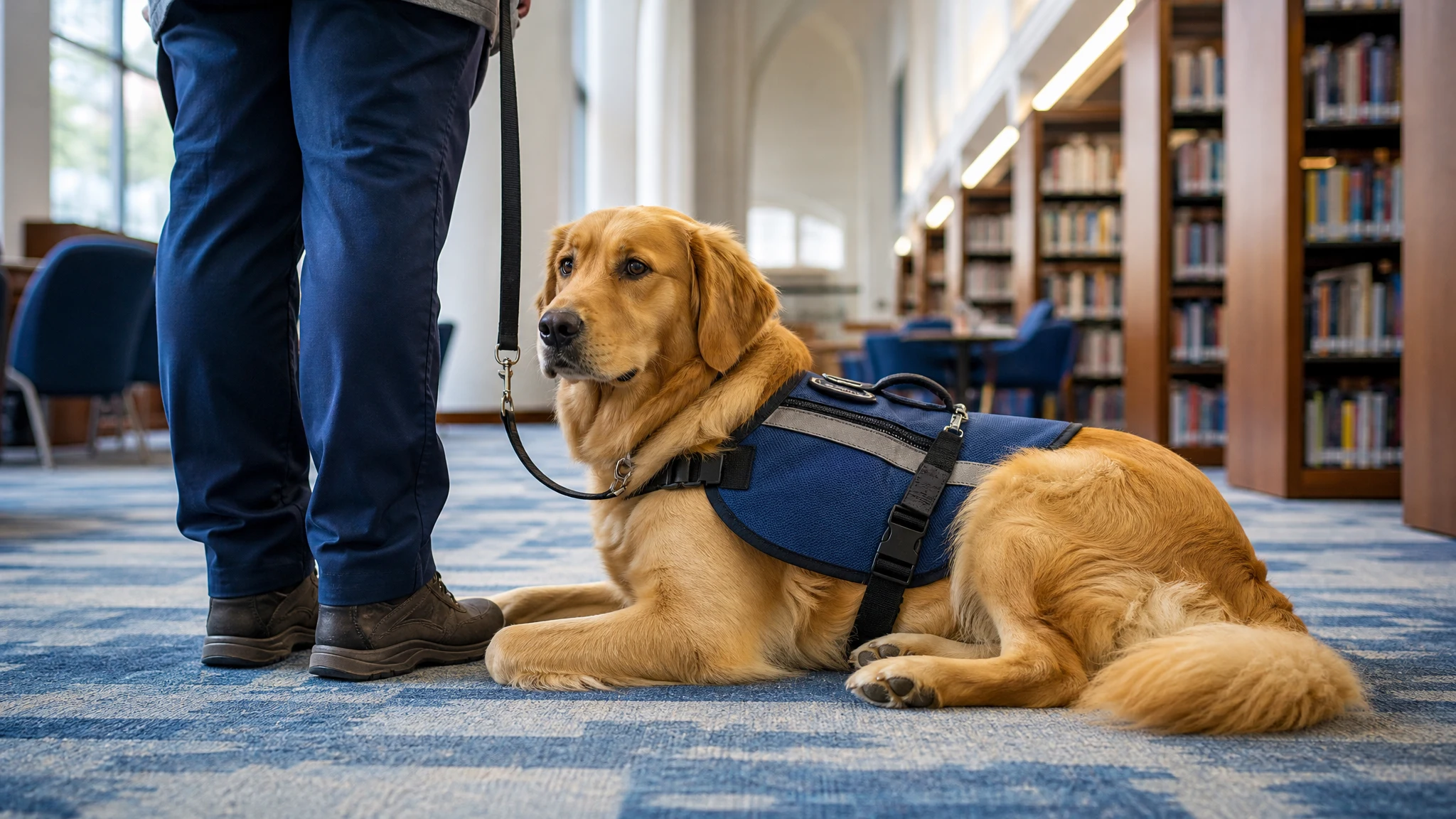
This page explains the law in general terms. It is not legal advice. For a specific situation, contact the agency listed on this site or an attorney.
A service dog can change how a person with a disability moves through daily life. In Washington, two sets of rules decide what that dog is, where it can go and what happens when someone gets in the way. Federal law sets a baseline. Washington law adds its own definitions, its own protections for dogs in training and its own penalties.
This guide explains how a service dog is defined under the ADA and Washington law. It covers the two main routes to a trained dog, what training involves, and how to start. It also covers what the law says about public places, housing and work, and which Washington organizations you can contact. It is general information, not legal advice. Where a question is about your own situation, the agencies and organizations named below are the right place to ask.
Contents
- Who qualifies and what counts as a service dog
- What does not count, and why there is no registry
- Your access rights in Washington
- Two routes: program-trained or owner-trained
- What service dog training involves
- Washington organizations and veteran resources
- Costs, timelines and where to start
- Sources
Key takeaways
- Under the ADA, a service animal is a dog individually trained to do work or perform tasks for a person with a disability. The tasks must be directly related to the disability.
- Emotional support, therapy and comfort animals are not service animals under the ADA. Washington's public access law uses a similar task-based definition.
- There is no official service dog registry or required certification, at the federal level or in Washington. Online certificates and ID cards carry no ADA rights.
- You do not need a professional trainer. The Department of Justice says people with disabilities may train the dog themselves.
- Since the 2024 amendments, Washington law also protects service animal trainees in places open to the public. The ADA does not cover dogs in training. Hotels and similar lodging are an exception to the state rule.
- Misrepresenting an animal as a service animal or trainee in Washington is a civil infraction with a $500 maximum penalty.
- To file a complaint, contact the Washington State Human Rights Commission.
Who qualifies and what counts as a service dog
The federal definition
The U.S. Department of Justice, on ADA.gov, defines service animals as dogs that are individually trained to do work or perform tasks for people with disabilities. The task must be directly related to the person's disability. A dog whose only function is comfort or emotional support does not qualify.
Notice what the definition leaves out. It does not list approved disabilities. It does not name breeds or sizes. It does not require a vest, a letter or a certificate. The test is what the dog has been trained to do.
The Washington definition
Washington's Law Against Discrimination defines a service animal in RCW 49.60.040. It is any dog or miniature horse individually trained to do work or perform tasks for a person with a physical, sensory, psychiatric, intellectual or other mental disability. The tasks must be directly related to the disability. The statute says crime-deterrent effects and emotional support, comfort or companionship are not work or tasks.
So for public places, the state and federal definitions line up closely. The main difference is that Washington's public access law also names trained miniature horses. Under RCW 49.60.215, places must make reasonable modifications for a trained miniature horse.
A second Washington law with a broader definition
Washington has an older law as well, the White Cane Law in chapter 70.84 RCW. It uses a broader definition. Under RCW 70.84.021, a service animal there is an animal trained to assist or accommodate a sensory, mental or physical disability. The two laws overlap, so it helps to know which one a source is talking about. Under RCW 70.84.070, denying or interfering with access is a misdemeanor.
The housing exception
The Law Against Discrimination definition of a service animal in RCW 49.60.040 does not apply to the housing sections of the law (RCW 49.60.222 through .227). Housing follows different rules, covered in the access section below.
Who can have a service dog
Neither the ADA nor Washington's statute sets a list of qualifying conditions. A service dog is for a person with a disability who needs the dog's trained work or tasks. The Washington definition names physical, sensory, psychiatric, intellectual and other mental disabilities. Programs describe the work in practical terms. The Washington organizations listed later in this guide mention mobility support, hearing, seizure response, diabetic alert, psychiatric and PTSD work, and autism support.
What does not count, and why there is no registry
Emotional support, therapy and comfort animals
Emotional support animals, therapy dogs and comfort animals are not service animals under the ADA. A therapy dog visits hospitals or schools to comfort other people. An emotional support animal helps through its presence. Both can be valuable. Neither is a service dog in the legal sense, because neither is individually trained to perform tasks tied to its handler's disability.
Washington's public access law draws the same line. Emotional support, comfort and companionship are not work or tasks under RCW 49.60.040. That is why an emotional support animal does not have general public access rights in stores and restaurants.
There is no official registry or certificate
The Washington State Human Rights Commission says there is no state or federal service animal registry or certification process. RCW 49.60.214 also bars requiring proof that an animal is certified, trained or licensed as a service animal.
The Department of Justice is equally direct. Online service animal certification or registration documents convey no ADA rights, and the Department does not recognize them. The ADA also does not permit mandatory service animal registration. If a website offers to register or certify your dog for a fee, it cannot give you legal proof of anything. This guide does not link to such sellers.
Local dog licensing still applies
A service dog is still a dog. According to the Department of Justice's FAQ, service animals are subject to the same local dog licensing, registration and vaccination rules as all dogs. Check your city or county for what applies where you live.
Your access rights in Washington
Public places
Under RCW 49.60.215, it is an unfair practice to deny, restrict or charge more because of a person's use of a trained dog guide or service animal in any place of public resort, accommodation, assemblage or amusement. That covers restaurants, shops, theaters and similar places.
The access is not unlimited. The statute says behavior that risks property or other persons can be grounds for refusal. A well-trained dog that stays calm and under control is what makes the rights workable in practice.
The two questions
According to ADA.gov, when it is not obvious that a dog is a service animal, staff may ask only two things:
- Is the dog a service animal required because of a disability?
- What work or task has the dog been trained to perform?
Staff cannot ask about the person's disability, require documentation or ID, or ask the dog to demonstrate its task. This is also why vests and cards are not required. Washington's misrepresentation rules, covered below, rely on the same two questions.
Dogs in training
The ADA does not cover dogs in training. The Department of Justice notes that some state or local laws do. Washington is one of them.
The 2024 amendments (session law 2024 c 161) added the terms "service animal trainee" and "service animal trainer" to RCW 49.60.040. A trainee is any dog or miniature horse undergoing training to become a service animal. A trainer is any individual exercising care, custody and control over the trainee during a course of training. The statute does not state a professional credential, disability, age or ID requirement for a trainer.
Under RCW 49.60.215, a place of public accommodation may not deny a trainer with a trainee access to the areas open to the public. There are conditions:
- The trainer must keep control with a harness, leash or tether. Voice or signals are allowed if a tether would interfere with the task being trained.
- The place may require removal of a trainee that is not housebroken or is out of control.
- The trainer can be charged for damage if the place customarily charges others for damage.
There is one important exception. The trainee provisions do not apply to places conducted for the housing or lodging of transient guests, such as hotels (RCW 49.60.040). Older guides, including the Human Rights Commission's 2019 publication, were written before this change and do not mention trainees. Confirm current details with the Commission if a business pushes back. The effective date of the 2024 law should also be checked with the Legislature or the Commission.
Misrepresentation
RCW 49.60.214 makes it a civil infraction to misrepresent an animal as a service animal or service animal trainee, expressly or by implication, to secure disability rights, when the person knew or should have known it does not qualify. Under RCW 7.80.120, the maximum penalty and default amount is $500. Businesses may post signs warning of the up-to-$500 infraction (RCW 49.60.215).
An enforcement officer may ask the two permitted questions. Refusing to answer creates a presumption that the animal is not a service animal. Separately, RCW 70.84.060 makes it unlawful for a person who is not disabled to use a dog guide or service animal in public places to claim the rights that chapter gives disabled people.
An older Human Rights Commission guide says the infraction is "up to $250." The current statute sets $500, so rely on the RCW.
Housing
RCW 49.60.222 makes discrimination in real estate transactions an unfair practice when it is based on disability or the use of a trained dog guide or service animal. That includes refusing reasonable accommodations and modifications.
Housing is broader than public access. The Human Rights Commission says assistance animals, including emotional support animals, can be reasonable accommodations with no training requirement. A note from a medical provider usually supports the request. That guidance dates from 2019, and federal housing guidance from HUD has since changed. Check the Commission and HUD for current rules before you rely on either.
Employment
Under RCW 49.60.180, employers may not refuse to hire, discharge or discriminate because of a person's use of a trained dog guide or service animal. The Human Rights Commission says an employer may refuse a trained service animal only if it poses an immediate or reasonably foreseeable risk. An untrained emotional support animal is handled through the reasonable accommodation interactive process instead.
Where to file a complaint
If you believe you were unlawfully denied access, the agency to contact is the Washington State Human Rights Commission. It accepts complaints through its online complaint form and by phone at 1-800-233-3247. The Department of Justice's service animal FAQ explains the federal side.
Two routes: program-trained or owner-trained
There are two main ways to end up with a trained service dog. Neither is required by law, and neither is the only right choice.
Route one: a dog from a program
Assistance dog organizations breed, raise or select dogs, train them and place them with people who have disabilities. Some are accredited by Assistance Dogs International (ADI), a coalition that sets standards for the field. Some of the Washington organizations below provide dogs at no charge to the person receiving them.
The trade-offs are practical. Programs usually have applications, eligibility criteria and waitlists. They may focus on certain kinds of work, such as mobility, or on certain groups, such as veterans. Some serve a wide region, so the program is not always in your city. Waitlist information is not published for the organizations in this guide. Ask each one directly.
Route two: training the dog yourself
The Department of Justice states that professional training is not required. People with disabilities may train the dog themselves. Many owner-trainers work with a dog they already have, and some hire a trainer for part of the process.
Owner-training asks a lot. You need time, consistency and a dog with the right temperament. You also need to be honest about whether the dog is suited to the work. Not every dog is, and a dog that is anxious, reactive or easily distracted in public may not be a fair match for the job. Support from a qualified positive-reinforcement trainer can help you judge this.
One Washington-based resource for this route is Atlas Assistance Dogs, covered below. It helps people train their own dogs rather than providing trained dogs.
Choosing between them
| Question | Program-trained | Owner-trained |
|---|---|---|
| Legal requirement | None | None |
| Who does the training | The organization and its trainers | You, with optional professional help |
| Eligibility and waitlist | Set by each program; ask directly | None, apart from any program or trainer you work with |
| Cost | Varies; some programs are free to recipients | Varies with the help you choose; trainers set their own rates |
| Dog selection | Chosen and matched by the program | Your own dog, or one you select |
What service dog training involves
Two layers: good manners and disability-related tasks
Service dog training has two layers. The first is general behavior. The dog needs to be housebroken, to stay under control around people, other animals, food and noise, and to settle quietly while its handler goes about the day. In Washington, control is a practical requirement. A place can refuse a dog whose behavior risks property or other persons, and it can ask for removal of a trainee that is out of control or not housebroken.
The second layer is task training. The ADA requires that the dog be trained to do work or perform tasks directly related to the handler's disability. The tasks depend on the person. Programs mention things like mobility assistance, alerting to a sound, responding to a seizure, alerting to a diabetic change, and interrupting or responding to psychiatric symptoms. A dog that simply provides comfort does not meet the definition.
Humane, reward-based methods
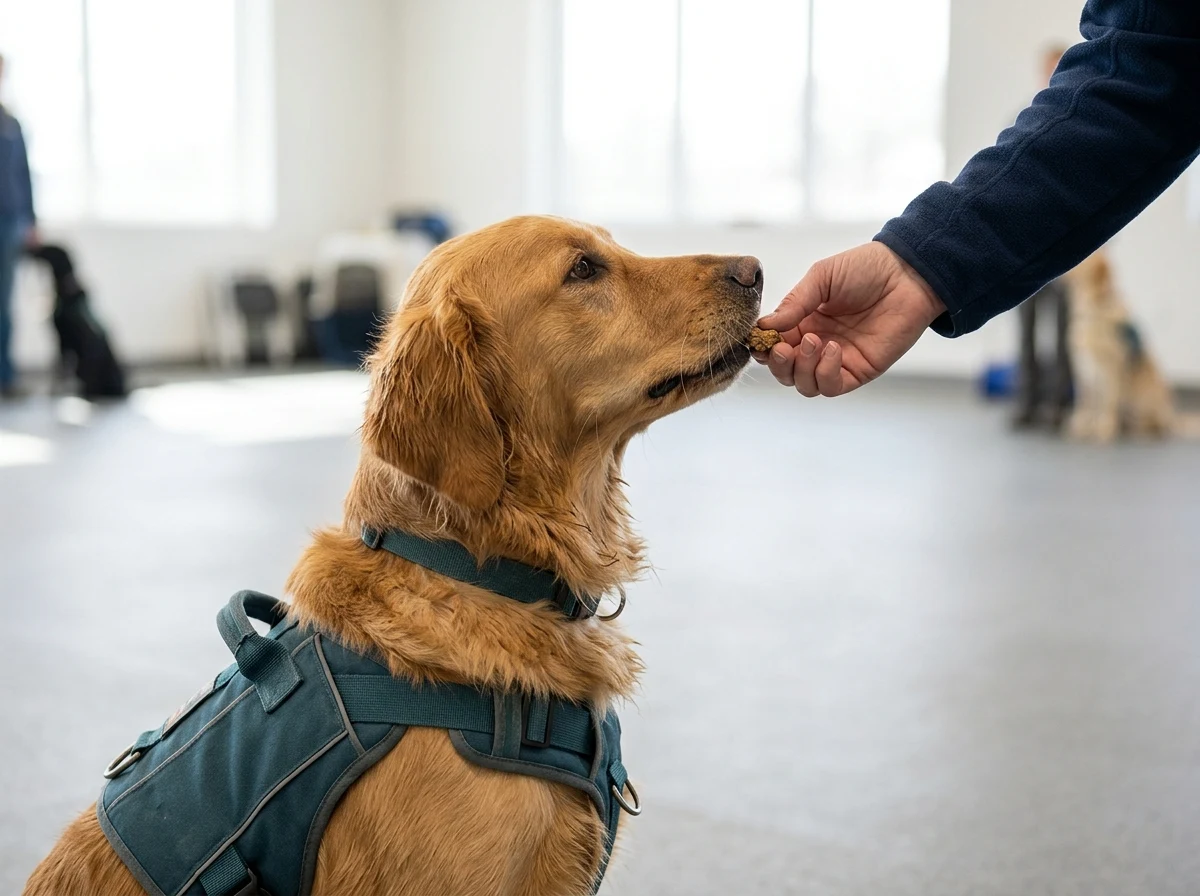
Modern service dog training uses reward-based methods, in line with the position of the American Veterinary Society of Animal Behavior (AVSAB). Dogs learn through rewards such as treats, praise and play, with patient repetition and gradual exposure to new places. Methods built on pain, fear or intimidation are not appropriate. That means no shock, prong or choke collars, no alpha rolls or scruffing, and no dominance-based techniques.
This is also practical. A dog that works because it is confident and rewarded tends to be steadier in busy environments than one working to avoid punishment. When you evaluate a trainer or program, ask how they motivate and correct a dog, and walk away from anyone who relies on force.
A typical progression
Every dog and handler is different, and no guide can promise how long it will take. In general, though, training moves in stages:
- Foundations. Basic cues, calm behavior, handling comfort, house manners and early socialization.
- Task teaching. Breaking each task into small steps and rewarding each one until the dog performs it reliably and on cue, or on its own when the situation calls for it.
- Public practice. Building up from quiet places to busier ones, with the dog staying focused despite crowds, food, other dogs and unfamiliar surfaces.
- Handler skills. You learn to read the dog, reinforce good work, keep control and manage questions from staff.
- Maintenance. Skills need ongoing practice and periodic refreshers.
Training in public in Washington
Public practice is where Washington's trainee rule matters. Since the 2024 amendments, a person with care, custody and control of a dog in training can bring it into areas open to the public, with the control and housebreaking conditions described above. The trainee has to stay under control on a leash, harness or tether, and you may be charged for any damage if the business customarily charges others. Hotels and other transient lodging are not covered by the trainee rule, so ask before bringing a trainee there.
Washington organizations and veteran resources
The organizations below come from Assistance Dogs International's member listings and each group's own website. Costs and waitlists are not published for most of them, so contact each directly. Being listed here is not an endorsement or a guarantee that a program fits your needs.
Program summaries
- Assistance Dogs Northwest, Bainbridge Island. ADI accredited. Serves people needing mobility dogs and facility dogs, across Idaho, Oregon and Washington. Its website says assistance dogs and lifetime follow-up support are provided free of charge.
- Atlas Assistance Dogs, mailing address in Bellevue. ADI accredited. It helps people train their own dogs, which must be at least 14 months old. It does not provide trained dogs. It lists support for autism, diabetic alert, hearing, mobility, psychiatric, PTSD, seizure and veteran needs. Its page says independent trainers set their own rates, so ask for current costs.
- Brigadoon Service Dogs, Bellingham. ADI accredited. Serves veterans, children and adults, including autism, mobility, PTSD and psychiatric needs, and provides facility dogs. ADI lists its service area as the Pacific Northwest, including the U.S. and Canada. Check with Brigadoon for costs and waitlist.
- Summit Assistance Dogs, Anacortes. ADI accredited. Serves people needing mobility dogs in Washington, Oregon and Idaho. Check with the organization for cost and waitlist.
- Paws for Purple Hearts, Washington, Tacoma. ADI accredited. Works with service members and veterans facing mobility and trauma challenges, including active-duty military and military-related PTSD. Check with the organization for cost and waitlist.
- Canine Companions, Northwest region served from Santa Rosa, California. ADI accredited and listed under California, but ADI lists Washington among the states it serves. It provides mobility, hearing, autism, veteran and facility dogs. Its website says every service and facility dog is free to those it serves.
Quick comparison
| Organization | Based in | Focus | Cost to recipient |
|---|---|---|---|
| Assistance Dogs Northwest | Bainbridge Island | Mobility, facility dogs | Free, per its website |
| Atlas Assistance Dogs | Bellevue (mailing) | Support for owner-trained dogs | Trainers set own rates |
| Brigadoon Service Dogs | Bellingham | Veterans, children, adults, facility dogs | Ask the organization |
| Summit Assistance Dogs | Anacortes | Mobility | Ask the organization |
| Paws for Purple Hearts, Washington | Tacoma | Veterans, active-duty military | Ask the organization |
| Canine Companions | Santa Rosa, CA (serves Washington) | Mobility, hearing, autism, veterans, facility dogs | Free, per its website |
ADI lists only five member organizations based in Washington, and Canine Companions is listed under California. Other programs and trainers exist that are not on this list. If you consider one, ask about its training methods, what it provides, what it expects of you and how it handles problems after placement.
Veteran resources
The U.S. Department of Veterans Affairs does not provide service dogs. Its Service Dog Veterinary Health Benefit provides veterinary health care and other benefits for guide dogs and for hearing and mobility service dogs prescribed to veterans with visual, hearing or substantial mobility impairment (38 CFR 17.148). To be recognized for the benefit, the dog and veteran must have completed a program from an organization accredited by ADI or one other accreditor listed on the VA page. Read the VA page and ask your VA care team about eligibility before you choose a program.
Paws for Purple Hearts and Brigadoon Service Dogs, both described above, also work with veterans.
Costs, timelines and where to start
What it costs
There is no single price for a service dog in Washington, and this guide does not quote one. Two of the organizations above, Assistance Dogs Northwest and Canine Companions, say on their websites that their dogs are provided free of charge to recipients. Atlas says independent trainers set their own rates. For the other programs, no cost is published, so ask.
If you train your dog yourself, you will still have costs: veterinary care, equipment, local dog licensing, classes and any trainer you hire. The ADA also does not make a business responsible for those costs. Plan your budget with realistic quotes from the people you work with.
How long it takes
Waitlist times are not published for these programs, and owner-training time depends on your dog and your schedule. Be wary of anyone who promises a fast timeline or a guaranteed outcome.
A step-by-step way to begin
- Define the need. Write down which tasks would help with your disability. Talk with your health care providers if you are unsure. The ADA requires the dog's tasks to be directly related to the disability.
- Choose a route. Decide between a program-trained dog, an owner-trained dog or a mix, with a trainer helping you through part of the process.
- Contact programs. Ask each about eligibility, the application process, costs, waitlists, service area and training methods. If you are a veteran, ask your VA care team about the veterinary benefit as well.
- If owner-training, assess the dog. Look at temperament, health and age, and find a trainer who uses reward-based methods. Atlas, for example, requires the dog to be at least 14 months old for its program.
- Train in stages. Build foundations, teach tasks, then practice in public. Know your rights as a trainer under Washington law, and know the limits, including hotels and lodging.
- Handle licensing. Comply with your local dog license and vaccination rules, which apply to service dogs too.
- Know the access rules. Learn the two permitted questions and be ready to answer them calmly. You do not need to carry papers, and you should not buy a registration or certificate.
- Keep working. Continue practicing and refreshing skills. If you are denied access, document what happened and contact the Human Rights Commission.
Housing and work planning
Think about housing and employment early. If you rent, the Human Rights Commission says assistance animals can be reasonable accommodations, and a note from a medical provider usually supports the request. If you work, RCW 49.60.180 protects the use of a trained service animal, with the exception for immediate or reasonably foreseeable risk. For air travel, check the current rules with the U.S. Department of Transportation before you book.
Final thoughts
The law around service dogs in Washington is simple at its core. A service dog is a dog trained to do tasks for a person's disability. No registry or certificate is needed, and you may train the dog yourself. Washington adds protections for dogs in training and a $500 civil penalty for misrepresentation. From there, the work is practical: pick a route, ask good questions of programs and trainers, and build steady, humane training.
Sources
- U.S. Department of Justice, ADA.gov: ADA Requirements, Service Animals
- U.S. Department of Justice, ADA.gov: Frequently Asked Questions about Service Animals and the ADA
- Washington State Legislature: RCW 49.60.040 (definitions)
- Washington State Legislature: RCW 49.60.215 (public accommodation)
- Washington State Legislature: RCW 49.60.214 (misrepresentation)
- Washington State Legislature: RCW 7.80.120 (civil infraction penalties)
- Washington State Legislature: RCW 49.60.222 (real estate and housing)
- Washington State Legislature: RCW 49.60.180 (employment)
- Washington State Legislature: RCW 70.84.060 (White Cane Law, misuse)
- Washington State Legislature: RCW 70.84.070 (White Cane Law, interference)
- Washington State Human Rights Commission: Guide to Service Animals and the Washington State Law Against Discrimination (Feb. 2019)
- Washington State Human Rights Commission: Disability in public accommodation
- U.S. Department of Veterans Affairs: Service Dog Veterinary Health Benefit
- Assistance Dogs International: Washington member search